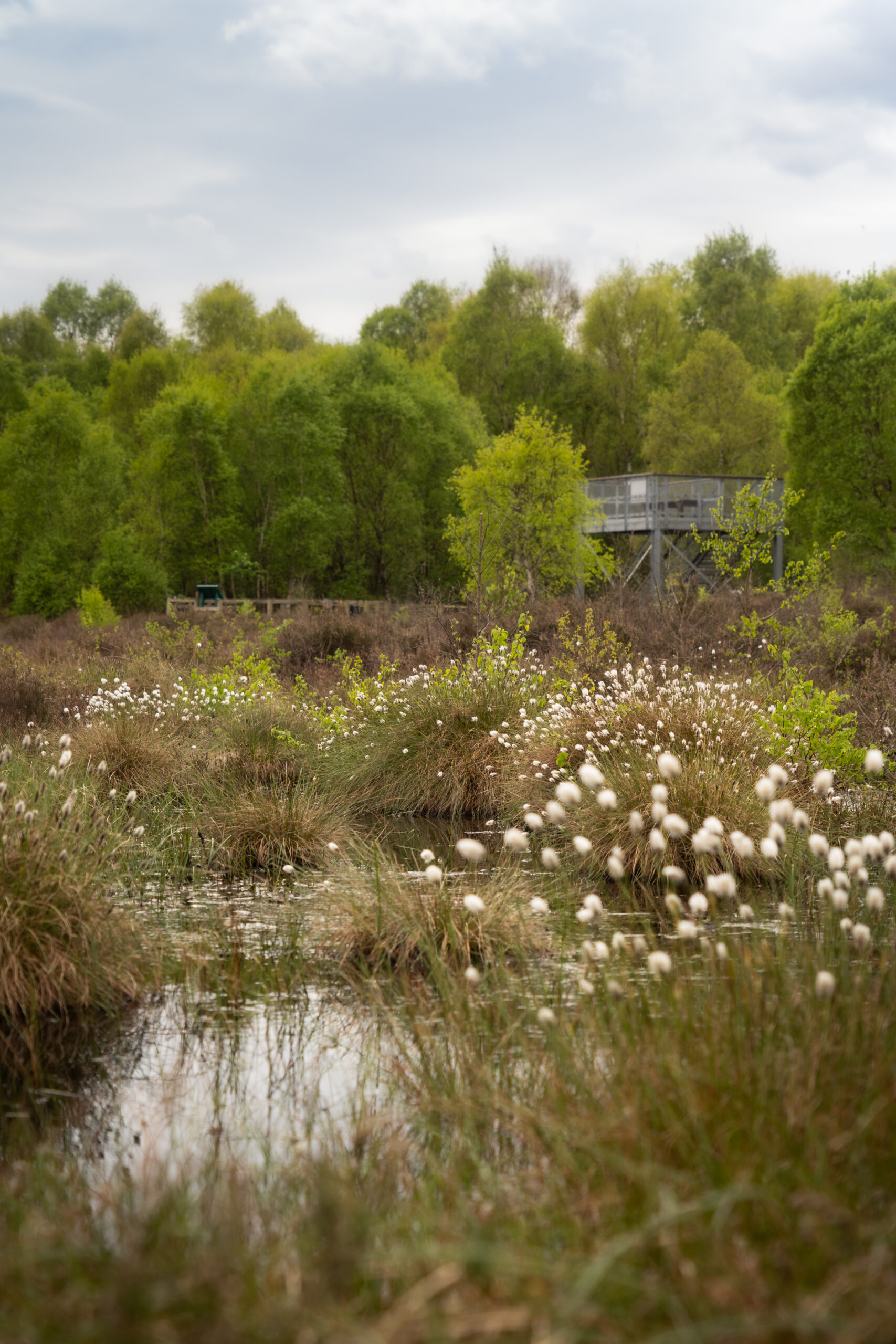
The Autumn 2026 issue of Moor Space, the newsletter for the Humberhead Peatlands National Nature Reserve, is out now. It covers a dry summer on the moors, how much carbon the bog is losing and a rare beetle that may have been hiding here for centuries.
What’s inside
A dry summer on the moors
Another very dry summer brought a higher risk of wildfire. In his welcome, LIFE Moor Space Project Manager Paul Schofield explains why the reserve was closed to visitors for a while. This was the first time it had been closed when there was no fire on site.
“When bare peat dries out, it can oxidise and release stored carbon dioxide (CO2) into the atmosphere.”
Paul Schofield, LIFE Moor Space Project Manager
Paul also gives an update on trials moving mature bog plants into the project area. The sundew is thriving, but cross-leaved heath has proved much harder to move. Bog rosemary and bog cranberry are next. This autumn, volunteers will help plant a further 6,000 sphagnum plugs. This is the final phase of the plug planting programme.
Counting the carbon on Thorne Moors
LIFE Moor Space Technical Officer Lewys Wheeler used the Peatland Code Carbon Calculator, drone surveys and GIS mapping to measure the greenhouse gas emissions from the 428 hectare project area.
The project area in numbers
- 34.54 ha of bare peat emits around 612 tCO2e a year
- 319.79 ha of modified bog emits around 802.68 tCO2e a year
- In total, around 1,441.9 tCO2e a year. That is about the same as boiling a kettle nearly 29 million times.
These figures give the project a baseline for measuring future carbon savings. Across the UK, peatlands are estimated to emit more than 15 million tonnes of CO2e each year. Restoring them stops these emissions and, over time, helps the bog take carbon back out of the atmosphere.
Meet the “Hatfield Redcoat”
In 2021 a very rare click beetle with bright red wing cases, Ampedus pomonae, was found on Hatfield Moors. It was spotted sunbathing on a birch leaf near the reconstructed Neolithic trackway. Senior Reserve Manager Julian Small explains why it may have been on the moor for centuries without anyone noticing.
“It does not have a common name, perhaps we should call it the Hatfield Redcoat.”
Julian Small, Senior Reserve Manager
Partnership work on Hatfield and Thorne Moors
Joe Carter of Yorkshire Wildlife Trust writes about this year’s Nature for Climate work. Volunteers from the Lindholme Old Moor Management Group, Gomde UK, the National Trust and Yorkshire Wildlife Trust came together to plant sphagnum. The team also visited a sphagnum grower, installed new sluices and surveyed invasive rhododendron. The issue also says farewell to Sarah Pullien after five years leading peatland restoration on the moors.
Restoring Crowle Moors
Megan Hall, Project Officer, gives an update from Crowle Moors. She also introduces a series of upcoming on-farm and conference-style events for farmers, landowners and land managers in the area.
Get involved
- Volunteer: help plant sphagnum this autumn, or join the team on Crowle Moors.
- Farmers and landowners: tell us what you would like the upcoming events to cover.
- Ramblers Wellbeing Walks: every Wednesday from Boston Park car park, Hatfield Moors. 9.30am on the first and third Wednesday of the month, 2pm on the second and fourth. No need to book.
- Get Moor Space by email: ask to receive future issues.
For any of these, email the team at humberhead.peatlands@naturalengland.org.uk. Past issues of Moor Space are on the LIFE Moor Space project page.